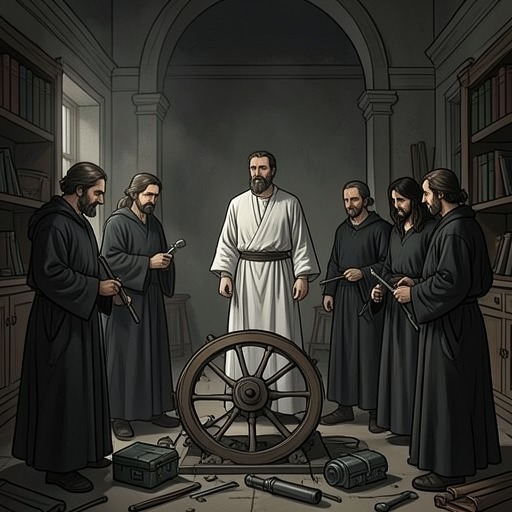
The Minna Men destroy the Ferris wheel
Motherless BrooklynThe Minna Men destroy the Ferris wheel in a closed carnival lot under Frank Minna’s direction, turning an unexplained nighttime assignment into a deliberate act of demolition. The episode’s force lies not only in the damage but in the way the men carry it out: the narrator describes a group that falls into its old obedience, works without needing further instructions, and acts as one body. The destruction becomes a measure of the Agency’s cohesion at its mature peak—and of how readily that cohesion can serve an absurd purpose.
Causes and Approach
The assignment begins with a telephone call and a practical objection: the narrator asks whether all four of them are needed, hoping to avoid what he imagines will be a crowbar-and-lug-wrench job. Frank Minna insists that everyone is going. Twenty minutes later, the group is equipped with pipes, a lug wrench, a car jack, and a souvenir baseball bat from Bat Day. They set out in Minna’s old Impala, described as the least distinguished of L&L’s many cars. Even before the destination is clear, the narrator reads the vehicle as another bad sign.
Minna drives a circuitous route: down Wyckoff, past the projects, around and south on Fourth Avenue to President Street, then back toward Court. He checks his watch and appears to be stalling. The detour delays the explanation, keeping the men in motion while the errand remains obscure. They eventually turn onto Smith and park a block below an empty supermarket lot. The carnival has shut for the night; plywood covers the concessions, the rides are still, and discarded beer cups and sausage wrappers lie across the moonlit ground. The subdued, abandoned setting contrasts with the work the men are about to begin.
The Attack on the Wheel
The men enter the lot carrying their tools. Minna leads without speaking, and their earlier resistance gives way to what the narrator calls their deep, obedient rhythm as his men. He points to the Ferris wheel and orders them to take it out. When the narrator hesitates, Minna makes the instruction explicit: they are to destroy it. The brief exchange converts the wheel from an unexplained destination into the target of a collective job.
Gilbert Coney understands first. He swings a piece of pipe at a strip of neon, breaking it and sending silver dust down. Tony Vermonte, Danny Fantl, and the narrator follow his lead. At first they test their strength with tentative blows; then they attack more forcefully. The neon gives way easily, but the wheel’s frame resists. They seek out its joints and vulnerable welds, pry up electrical cable, and chop into it with the sharp edge of the wrench until its insulation and wire are exposed and mangled.
Frank Minna joins the damage with the souvenir Yankee bat, striking the gates that hold riders in their seats. He splinters the wood without breaking the gates, but bends them out of shape. Inside the wheel’s frame, Gilbert and the narrator put their combined weight against one of the chairs until its hinge ruptures. They then locate the brake and release it, allowing the wheel to turn so they can reach more of it. The sequence is practical as well as destructive: the men do not merely strike at the amusement but work through its lights, cables, restraints, joints, chair, and brake.
Collective Action and Significance
Two Dominican teenagers watch from across the street. The men ignore them and continue, hurrying without becoming frantic. Minna remains in command, yet the group no longer needs him to explain each move. The narrator’s description stresses this paradox: they are entirely directed by Minna and, at the same time, capable of carrying out the task without further direction. Their coordination is the scene’s defining consequence. The episode presents the Agency not as a formal office or a set of procedures but as a practiced bond of command and response.
The narrator calls this the Agency at its mature peak: unquestioning and thorough in carrying out an action that borders on sheer Dada. That judgment preserves the scene’s contradiction rather than resolving it. The men demonstrate discipline, shared competence, and loyalty, but their collective skill is being spent on wrecking a carnival ride for a purpose the episode does not explain. The discarded wrappers, battered attractions, and improvised tools give the operation the shape of serious work while its object makes that seriousness seem absurd. The Ferris wheel is attacked with method; the reason for attacking it remains unstated. Thus the scene makes the group’s unity vivid while leaving the wisdom or purpose of its obedience unsettled.